


Great-tailed Grackle
Quiscalus mexicanus
- KingdomAnimalia (Animals)
- PhylumChordata (Cordats)
- ClassAves (Aus)
- OrderPasseriformes
- FamilyIcteridae (Ictèrids)
- GenusQuiscalus (Typical Grackles)
- SpeciesQuiscalus mexicanus (Great-tailed Grackle)
The great-tailed grackle or Mexican grackle (Quiscalus mexicanus) is a medium-sized, highly social passerine bird native to North and South America. A member of the family Icteridae, it is one of 10 extant species of grackle and is closely related to the boat-tailed grackle and the extinct slender-billed grackle. In the southern and southwestern United States, the grackle is sometimes referred to simply as a "blackbird" or (erroneously) a "crow" due to its glossy black plumage; however, grackles form their own unique genus that is separate from other "blackbirds", such as the red-winged and Brewer's blackbirds, despite being in the same family (Icteridae). Superficially, Brewer's blackbird is one of the most visually similar species to grackles. In some parts of Mexico, the grackle is sometimes referred to in Spanish as cuervo ("raven"; "crow"), although it is not a member of the crow genus (Corvus) nor of their family (Corvidae). Wikipedia →
Closest Relatives at Everglades National Park

Boat-tailed Grackle
Quiscalus major
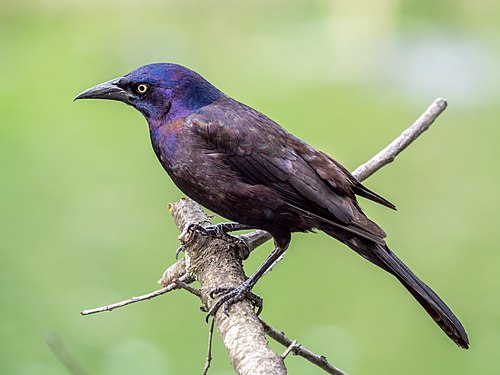
Common Grackle
Quiscalus quiscula

Red-winged Blackbird
Agelaius phoeniceus

Eastern Meadowlark
Sturnella magna

Brown-headed Cowbird
Molothrus ater

Shiny Cowbird
Molothrus bonariensis

Bronzed Cowbird
Molothrus aeneus

Bobolink
Dolichonyx oryzivorus

Baltimore Oriole
Icterus galbula

Spot-breasted Oriole
Icterus pectoralis

Yellow-headed Blackbird
Xanthocephalus xanthocephalus

Brewer's Blackbird
Euphagus cyanocephalus
📅 Monthly Probability
Fewer than 5 records of Great-tailed Grackle at Everglades National Park — not enough to chart months honestly.
☀️ When They're Spotted
Most active during daytime hours (6am–6pm) · across all parks (global)
Global Distribution
Where this species is recorded worldwide. Restricted to human observations from 2019 onwards — the same kind of record and the same period the probabilities on this page are built from, so collar-tracking studies, camera-trap arrays and museum specimens are excluded. Around Santa Rosa that removes 5,924 GPS fixes from a handful of tagged jaguars.
where this species is recorded (GBIF density — it tracks where observers go, not how likely a sighting is) · parks where it occurs — tap a pin for the sighting probability there