


American Barn Owl
Tyto furcata
- KingdomAnimalia (Animals)
- PhylumChordata (Cordats)
- ClassAves (Aus)
- OrderStrigiformes (Owls)
- FamilyTytonidae (Barn Owls)
- GenusTyto
- SpeciesTyto furcata (American Barn Owl)
The American barn owl (Tyto furcata) is usually considered a subspecies group and together with the western barn owl group, the eastern barn owl group, and sometimes the Andaman masked owl, make up the barn owl, cosmopolitan in range. The barn owl is recognized by most taxonomic authorities. A few (including the International Ornithologists' Union) separate them into distinct species, as is done here. The American barn owl is native to North and South America, and has been introduced to Hawaii. The ashy-faced owl (T. glaucops) was for some time included in T. alba, and by some authors its populations from the Lesser Antilles still are. Based on DNA evidence, König, Weick & Becking (2009) recognised the American barn owl (T. furcata) and the Curaçao barn owl (T. bargei) as separate species, though the latter is now considered a subspecies of the American barn owl (T. furcata bargei; see #Subspecies, below). Wikipedia →
Closest Relatives at Great Bear Rainforest

Northern Hawk Owl
Surnia ulula

Great Gray Owl
Strix nebulosa

Northern Pygmy Owl
Glaucidium californicum

Northern Pygmy-Owl
Glaucidium gnoma
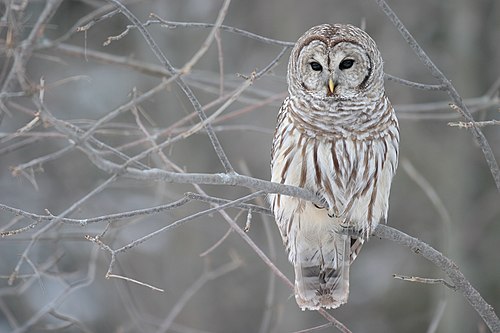
Barred Owl
Strix varia

Northern Saw-whet Owl
Aegolius acadicus

Great Horned Owl
Bubo virginianus

Short-eared Owl
Asio flammeus

Western Screech-Owl
Megascops kennicottii

Boreal Owl
Aegolius funereus

Snowy Owl
Bubo scandiacus

Long-eared Owl
Asio otus
📅 Monthly Probability
Fewer than 5 records of American Barn Owl at Great Bear Rainforest — not enough to chart months honestly.
☀️🌙 When They're Spotted
Active throughout day and night · across all parks (global)
Global Distribution
Where this species is recorded worldwide. Restricted to human observations from 2019 onwards — the same kind of record and the same period the probabilities on this page are built from, so collar-tracking studies, camera-trap arrays and museum specimens are excluded. Around Santa Rosa that removes 5,924 GPS fixes from a handful of tagged jaguars.
where this species is recorded (GBIF density — it tracks where observers go, not how likely a sighting is) · parks where it occurs — tap a pin for the sighting probability there