


Sanderling
Calidris alba
- KingdomAnimalia (Animals)
- PhylumChordata (Cordats)
- ClassAves (Aus)
- OrderCharadriiformes (Caradriformes)
- FamilyScolopacidae (Sandpipers and Allies)
- GenusCalidris (Calidris Sandpipers)
- SpeciesCalidris alba (Sanderling)
The sanderling (Calidris alba) is a small wading bird. It is a circumpolar Arctic breeder, being among the most extreme northern breeding birds in the world, nesting only on the coldest tundra, north of the 5°C July isotherm; in Europe, its southernmost breeding locality is Svalbard, where only a handful (5–15) pairs breed. It is a long-distance migrant, wintering south to South America, western and southern Europe, Africa, and Australia. It is highly gregarious in winter, sometimes forming large flocks on coastal mudflats or sandy beaches. It is somewhat unlike other small sandpipers in appearance, in particular in lacking a hind toe, which has led to the suggestion that it should be placed into a monotypic genus Crocethia. More recent reviews indicate that the sanderling is a fairly typical "stint" or small sandpiper and should be retained along with the knots and other relatives in the genus Calidris. Wikipedia →
<5% of wildlife watchers report a Sanderling sighting in Snowdonia National Park, based on 42 days of visitor records from GBIF citizen-science data.
Closest Relatives at Snowdonia National Park

Dunlin
Calidris alpina

Red Knot
Calidris canutus

Ruff
Calidris pugnax

Little Stint
Calidris minuta

Curlew Sandpiper
Calidris ferruginea

Purple Sandpiper
Calidris maritima

Eurasian Curlew
Numenius arquata

Common Redshank
Tringa totanus

Black-tailed Godwit
Limosa limosa
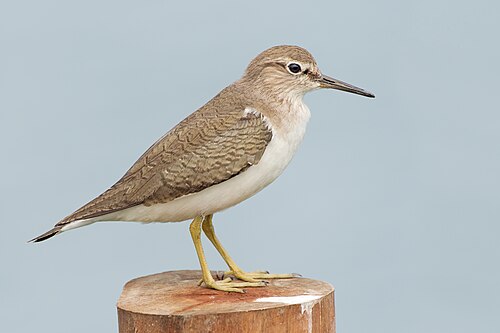
Common Sandpiper
Actitis hypoleucos

Common Greenshank
Tringa nebularia

Ruddy Turnstone
Arenaria interpres
📅 Monthly Probability
☀️ When They're Spotted
Most active during daytime hours (6am–6pm) · across all parks (global)
Global Distribution
Where this species is recorded worldwide. Restricted to human observations from 2019 onwards — the same kind of record and the same period the probabilities on this page are built from, so collar-tracking studies, camera-trap arrays and museum specimens are excluded. Around Santa Rosa that removes 5,924 GPS fixes from a handful of tagged jaguars.
where this species is recorded (GBIF density — it tracks where observers go, not how likely a sighting is) · parks where it occurs — tap a pin for the sighting probability there
Parks Where Found
Quick answers
What are the chances of seeing a Sanderling in Snowdonia National Park?
About 2% of wildlife watchers report a Sanderling sighting in Snowdonia National Park, based on 42 days of visitor records from GBIF citizen-science data.
When is the best time to see Sanderling in Snowdonia National Park?
November has the highest sighting rate for Sanderling in Snowdonia National Park in our monthly data.