


European Starling
Sturnus vulgaris
- KingdomAnimalia (Animals)
- PhylumChordata (Cordats)
- ClassAves (Aus)
- OrderPasseriformes
- FamilySturnidae (Starlings)
- GenusSturnus (European and Spotless Starlings)
- SpeciesSturnus vulgaris (European Starling)
The common starling (Sturnus vulgaris), also known simply as the starling in Great Britain and Ireland, and as the European starling in North America, is a medium-sized passerine bird in the starling family, Sturnidae. It is about 20 cm (8 in) long and has glossy black plumage with a metallic sheen, which is speckled with white at some times of the year. The legs are pink and the bill is black in winter and yellow in summer; young birds have browner plumage than the adults. Its gift for mimicry has been noted in literature including the Mabinogion and the works of Pliny the Elder and William Shakespeare. The common starling has about 12 subspecies breeding in open habitats across its native range in temperate Europe and across the Palearctic to western Mongolia, and it has been introduced as an invasive species to Australia, New Zealand, Canada, the United States, Mexico, Argentina, South Africa and Fiji. This bird is resident in western and southern Europe and southwestern Asia, while northeastern populations migrate south and west in the winter within the breeding range and also further south to Iberia and North Africa. Wikipedia →
Closest Relatives at Namib-Naukluft National Park

Pale-winged Starling
Onychognathus nabouroup

Red-shouldered Glossy-starling
Lamprotornis nitens

Red-winged Starling
Onychognathus morio

Wattled Starling
Creatophora cinerea
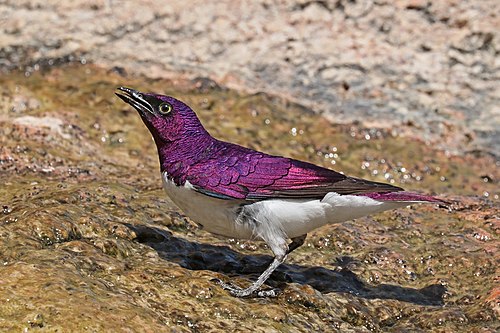
Violet-backed Starling
Cinnyricinclus leucogaster

Burchell's Glossy-starling
Lamprotornis australis

Cape Sparrow
Passer melanurus

Cape Wagtail
Motacilla capensis

African Red-eyed Bulbul
Pycnonotus nigricans

Familiar Chat
Oenanthe familiaris

Dusky Sunbird
Cinnyris fuscus

Southern Masked Weaver
Ploceus velatus
📅 Monthly Probability
Fewer than 5 records of European Starling at Namib-Naukluft National Park — not enough to chart months honestly.
☀️ When They're Spotted
Most active during daytime hours (6am–6pm) · across all parks (global)
Global Distribution
Where this species is recorded worldwide. Restricted to human observations from 2019 onwards — the same kind of record and the same period the probabilities on this page are built from, so collar-tracking studies, camera-trap arrays and museum specimens are excluded. Around Santa Rosa that removes 5,924 GPS fixes from a handful of tagged jaguars.
where this species is recorded (GBIF density — it tracks where observers go, not how likely a sighting is) · parks where it occurs — tap a pin for the sighting probability there