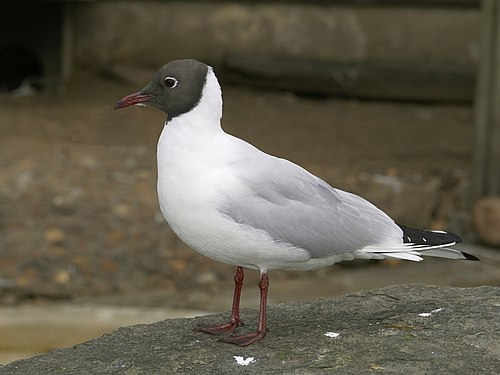


Black-headed Gull
Chroicocephalus ridibundus
- KingdomAnimalia (Animals)
- PhylumChordata (Cordats)
- ClassAves (Aus)
- OrderCharadriiformes (Caradriformes)
- FamilyLaridae (Gulls, Terns, and Skimmers)
- GenusChroicocephalus (Masked Gulls and allies)
- SpeciesChroicocephalus ridibundus (Black-headed Gull)
The black-headed gull (Chroicocephalus ridibundus) is a small gull that breeds in much of the Palearctic in Europe and Asia, and also locally in smaller numbers in coastal eastern Canada. Most of the population is migratory and winters further south, but many also remain in the milder areas of northwestern Europe. It was formerly sometimes cited as "common black-headed gull" to distinguish it from "great black-headed gull" (an old name for Pallas's gull). The genus name Chroicocephalus is from the Ancient Greek words khroizo, "to colour", and kephale, "head". The specific name ridibundus is Latin for "laughing". Wikipedia →
60–70% of wildlife watchers report a Black-headed Gull sighting in Wadden Sea National Park, based on 7,494 days of visitor records from GBIF citizen-science data.
Closest Relatives at Wadden Sea National Park

Bonaparte's Gull
Chroicocephalus philadelphia

European Herring Gull
Larus argentatus

Common Gull
Larus canus

Lesser Black-backed Gull
Larus fuscus

Great Black-backed Gull
Larus marinus

Common Tern
Sterna hirundo

Sandwich Tern
Thalasseus sandvicensis

Black-legged Kittiwake
Rissa tridactyla

Little Gull
Hydrocoloeus minutus

Mediterranean Gull
Ichthyaetus melanocephalus

Arctic Tern
Sterna paradisaea

Caspian Gull
Larus cachinnans
📅 Monthly Probability
☀️ When They're Spotted
Most active during daytime hours (6am–6pm) · across all parks (global)
Global Distribution
Where this species is recorded worldwide. Restricted to human observations from 2019 onwards — the same kind of record and the same period the probabilities on this page are built from, so collar-tracking studies, camera-trap arrays and museum specimens are excluded. Around Santa Rosa that removes 5,924 GPS fixes from a handful of tagged jaguars.
where this species is recorded (GBIF density — it tracks where observers go, not how likely a sighting is) · parks where it occurs — tap a pin for the sighting probability there
Parks Where Found
Quick answers
What are the chances of seeing a Black-headed Gull in Wadden Sea National Park?
About 61% of wildlife watchers report a Black-headed Gull sighting in Wadden Sea National Park, based on 7,494 days of visitor records from GBIF citizen-science data.
When is the best time to see Black-headed Gull in Wadden Sea National Park?
October has the highest sighting rate for Black-headed Gull in Wadden Sea National Park in our monthly data.