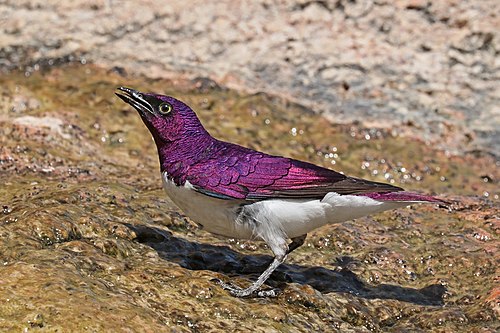


Violet-backed Starling
Cinnyricinclus leucogaster
- KingdomAnimalia (Animals)
- PhylumChordata (Cordats)
- ClassAves (Aus)
- OrderPasseriformes
- FamilySturnidae (Starlings)
- GenusCinnyricinclus
- SpeciesCinnyricinclus leucogaster (Violet-backed Starling)
The violet-backed starling (Cinnyricinclus leucogaster), also known as the plum-coloured starling or amethyst starling, or Ndambamukula in the Venda language, is a relatively small species (17 cm) of starling in the family Sturnidae. It is the only member of the genus Cinnyricinclus. This strongly sexually dimorphic species is found widely in the woodlands and savannah forest edges of mainland sub-Saharan Africa. It is rarely seen on the ground, but instead found in trees and other locations away from the ground. Wikipedia →
<5% of wildlife watchers report a Violet-backed Starling sighting in Semuliki National Park, based on 10 days of visitor records from GBIF citizen-science data.
Closest Relatives at Semuliki National Park

Purple-headed Starling
Hylopsar purpureiceps

Splendid Glossy-starling
Lamprotornis splendidus

Slender-billed Starling
Onychognathus tenuirostris

Narrow-tailed Starling
Poeoptera lugubris

Purple Glossy-Starling
Lamprotornis purpureus

Rüppell's Glossy-starling
Lamprotornis purpuroptera

Crested Malimbe
Malimbus malimbicus

Red-tailed Greenbul
Criniger calurus

Western Nicator
Nicator chloris

Fraser's Rufous Thrush
Stizorhina fraseri
Xavier's Greenbul
Phyllastrephus xavieri

Red-tailed Ant-Thrush
Neocossyphus rufus
📅 Monthly Probability
☀️ When They're Spotted
Most active during daytime hours (6am–6pm) · across all parks (global)
Global Distribution
Where this species is recorded worldwide. Restricted to human observations from 2019 onwards — the same kind of record and the same period the probabilities on this page are built from, so collar-tracking studies, camera-trap arrays and museum specimens are excluded. Around Santa Rosa that removes 5,924 GPS fixes from a handful of tagged jaguars.
where this species is recorded (GBIF density — it tracks where observers go, not how likely a sighting is) · parks where it occurs — tap a pin for the sighting probability there
Parks Where Found
Quick answers
What are the chances of seeing a Violet-backed Starling in Semuliki National Park?
About 3% of wildlife watchers report a Violet-backed Starling sighting in Semuliki National Park, based on 10 days of visitor records from GBIF citizen-science data.
When is the best time to see Violet-backed Starling in Semuliki National Park?
March has the highest sighting rate for Violet-backed Starling in Semuliki National Park in our monthly data.