


Green Iguana
Iguana iguana
- KingdomAnimalia (Animals)
- PhylumChordata (Cordats)
- ClassSquamata
- FamilyIguanidae (Iguanas and Chuckwallas)
- GenusIguana (Typical Iguanas)
- SpeciesIguana iguana (Green Iguana)
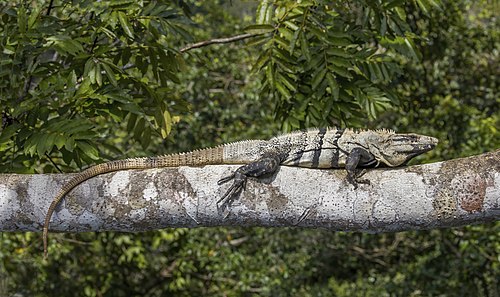
The green iguana (Iguana iguana), also known as the American iguana or the common green iguana, is a large, arboreal, mostly herbivorous species of lizard of the genus Iguana. Usually, this animal is simply called the iguana. The green iguana ranges over a large geographic area; it is native from southern Brazil and Paraguay as far north as Mexico. It is highly invasive in many subtropical and tropical environments throughout the world. A herbivore, it has adapted significantly with regard to locomotion and osmoregulation as a result of its diet. It grows to 1.7 m (5.6 ft) in length from head to tail, although a few specimens have grown more than 2 m (6.6 ft) with bodyweights upward of 9 kg (20 lb). Wikipedia →
Closest Relatives at Pico Bonito National Park
📅 Monthly Probability
Fewer than 5 records of Green Iguana at Pico Bonito National Park — not enough to chart months honestly.
☀️ When They're Spotted
Most active during daytime hours (6am–6pm) · across all parks (global)
Global Distribution
Where this species is recorded worldwide. Restricted to human observations from 2019 onwards — the same kind of record and the same period the probabilities on this page are built from, so collar-tracking studies, camera-trap arrays and museum specimens are excluded. Around Santa Rosa that removes 5,924 GPS fixes from a handful of tagged jaguars.
where this species is recorded (GBIF density — it tracks where observers go, not how likely a sighting is) · parks where it occurs — tap a pin for the sighting probability there