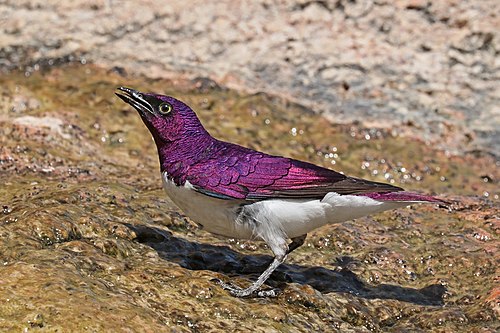


Violet-backed Starling
Cinnyricinclus leucogaster
- KingdomAnimalia (Animals)
- PhylumChordata (Cordats)
- ClassAves (Aus)
- OrderPasseriformes
- FamilySturnidae (Starlings)
- GenusCinnyricinclus
- SpeciesCinnyricinclus leucogaster (Violet-backed Starling)
The violet-backed starling (Cinnyricinclus leucogaster), also known as the plum-coloured starling or amethyst starling, or Ndambamukula in the Venda language, is a relatively small species (17 cm) of starling in the family Sturnidae. It is the only member of the genus Cinnyricinclus. This strongly sexually dimorphic species is found widely in the woodlands and savannah forest edges of mainland sub-Saharan Africa. It is rarely seen on the ground, but instead found in trees and other locations away from the ground. Wikipedia →
Closest Relatives at Niokolo-Koba National Park

Long-tailed Glossy Starling
Lamprotornis caudatus

Purple Glossy-Starling
Lamprotornis purpureus

Bronze-tailed Glossy-Starling
Lamprotornis chalcurus

Greater Blue-eared Starling
Lamprotornis chalybaeus

Lesser Blue-eared Glossy-starling
Lamprotornis chloropterus

Chestnut-bellied Starling
Lamprotornis pulcher

Yellow-crowned Gonolek
Laniarius barbarus

Common Bulbul
Pycnonotus barbatus

Beautiful Sunbird
Cinnyris pulchellus

Red-billed Firefinch
Lagonosticta senegala

African Pied Wagtail
Motacilla aguimp

Northern Grey-headed Sparrow
Passer griseus
📅 Monthly Probability
Fewer than 5 records of Violet-backed Starling at Niokolo-Koba National Park — not enough to chart months honestly.
☀️ When They're Spotted
Most active during daytime hours (6am–6pm) · across all parks (global)
Global Distribution
Where this species is recorded worldwide. Restricted to human observations from 2019 onwards — the same kind of record and the same period the probabilities on this page are built from, so collar-tracking studies, camera-trap arrays and museum specimens are excluded. Around Santa Rosa that removes 5,924 GPS fixes from a handful of tagged jaguars.
where this species is recorded (GBIF density — it tracks where observers go, not how likely a sighting is) · parks where it occurs — tap a pin for the sighting probability there