


Fulvous Whistling-Duck
Dendrocygna bicolor
- KingdomAnimalia (Animals)
- PhylumChordata (Cordats)
- ClassAves (Aus)
- OrderAnseriformes
- FamilyAnatidae (Anàtids)
- GenusDendrocygna (Whistling-Ducks)
- SpeciesDendrocygna bicolor (Fulvous Whistling-Duck)
The fulvous whistling duck or fulvous tree duck (Dendrocygna bicolor) is a species of whistling duck that breeds across the world's tropical regions in much of Mexico and South America, the West Indies, the southern United States, sub-Saharan Africa and the Indian subcontinent. It has plumage that is mainly reddish brown, long legs and a long grey bill, and shows a distinctive white band across its black tail in flight. Like other members of its ancient lineage, it has a whistling call which is given in flight or on the ground. Its preferred habitat consists of wetlands with plentiful vegetation, including shallow lakes and paddy fields. The nest, built from plant material and unlined, is placed among dense vegetation or in a tree hole. The typical clutch is around ten whitish eggs. Wikipedia →
<5% of wildlife watchers report a Fulvous Whistling-Duck sighting in South Luangwa National Park, based on 8 days of visitor records from GBIF citizen-science data.
Closest Relatives at South Luangwa National Park
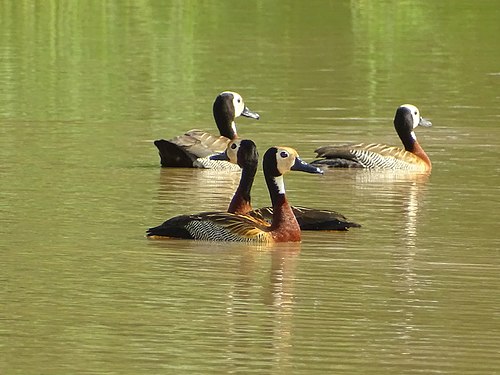
White-faced Whistling Duck
Dendrocygna viduata

Egyptian Goose
Alopochen aegyptiaca

Spur-winged Goose
Plectropterus gambensis

Comb Duck
Sarkidiornis melanotos

Red-billed Teal
Anas erythrorhyncha

African Pygmy-Goose
Nettapus auritus

Yellow-billed Duck
Anas undulata

White-backed Duck
Thalassornis leuconotus

Hottentot Teal
Spatula hottentota
📅 Monthly Probability
☀️ When They're Spotted
Most active during daytime hours (6am–6pm) · across all parks (global)
Global Distribution
Where this species is recorded worldwide. Restricted to human observations from 2019 onwards — the same kind of record and the same period the probabilities on this page are built from, so collar-tracking studies, camera-trap arrays and museum specimens are excluded. Around Santa Rosa that removes 5,924 GPS fixes from a handful of tagged jaguars.
where this species is recorded (GBIF density — it tracks where observers go, not how likely a sighting is) · parks where it occurs — tap a pin for the sighting probability there
Parks Where Found
Quick answers
What are the chances of seeing a Fulvous Whistling-Duck in South Luangwa National Park?
About 1% of wildlife watchers report a Fulvous Whistling-Duck sighting in South Luangwa National Park, based on 8 days of visitor records from GBIF citizen-science data.
When is the best time to see Fulvous Whistling-Duck in South Luangwa National Park?
March has the highest sighting rate for Fulvous Whistling-Duck in South Luangwa National Park in our monthly data.