


Wattled Starling
Creatophora cinerea
- KingdomAnimalia (Animals)
- PhylumChordata (Cordats)
- ClassAves (Aus)
- OrderPasseriformes
- FamilySturnidae (Starlings)
- GenusCreatophora
- SpeciesCreatophora cinerea (Wattled Starling)
The wattled starling (Creatophora cinerea) is a nomadic resident bird in eastern and southern Africa. It is a species of grassland, open woodland, and cultivation. This is the only African starling that appears to show affinities with the Asian starlings, particularly the genus Sturnus. Its bare face patches and ability to open-bill feed in grassland are unique amongst African starlings. It is the only member of the genus Creatophora. This common species appears to be extending its range into West Africa and has also occurred in Arabia, Madagascar, and Seychelles. Wikipedia →
Closest Relatives at Kibale National Park

Purple-headed Starling
Hylopsar purpureiceps
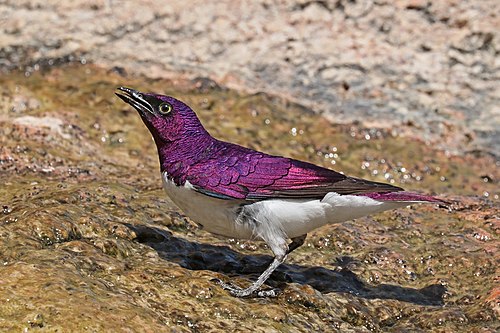
Violet-backed Starling
Cinnyricinclus leucogaster

Splendid Glossy-starling
Lamprotornis splendidus

Rüppell's Glossy-starling
Lamprotornis purpuroptera

Narrow-tailed Starling
Poeoptera lugubris

Waller's Starling
Onychognathus walleri

Chestnut-winged Starling
Onychognathus fulgidus

Stuhlmann's Starling
Poeoptera stuhlmanni

Purple Glossy-Starling
Lamprotornis purpureus

Greater Blue-eared Starling
Lamprotornis chalybaeus

Slender-billed Starling
Onychognathus tenuirostris

Common Bulbul
Pycnonotus barbatus
📅 Monthly Probability
Fewer than 5 records of Wattled Starling at Kibale National Park — not enough to chart months honestly.
☀️ When They're Spotted
Most active during daytime hours (6am–6pm) · across all parks (global)
Global Distribution
Where this species is recorded worldwide. Restricted to human observations from 2019 onwards — the same kind of record and the same period the probabilities on this page are built from, so collar-tracking studies, camera-trap arrays and museum specimens are excluded. Around Santa Rosa that removes 5,924 GPS fixes from a handful of tagged jaguars.
where this species is recorded (GBIF density — it tracks where observers go, not how likely a sighting is) · parks where it occurs — tap a pin for the sighting probability there