


Greater Blue-eared Starling
Lamprotornis chalybaeus
- KingdomAnimalia (Animals)
- PhylumChordata (Cordats)
- ClassAves (Aus)
- OrderPasseriformes
- FamilySturnidae (Starlings)
- GenusLamprotornis (Glossy Starlings and Allies)
- SpeciesLamprotornis chalybaeus (Greater Blue-eared Starling)
The greater blue-eared starling or greater blue-eared glossy-starling (Lamprotornis chalybaeus) is a bird that breeds from Senegal east to Ethiopia and south through eastern Africa to northeastern South Africa and Angola. It is a very common species of open woodland bird, and undertakes some seasonal migration. Wikipedia →
10–20% of wildlife watchers report a Greater Blue-eared Starling sighting in Aberdare National Park, based on 60 days of visitor records from GBIF citizen-science data.
Closest Relatives at Aberdare National Park

Superb Starling
Lamprotornis superbus

Rüppell's Glossy-starling
Lamprotornis purpuroptera

Hildebrandt's Starling
Lamprotornis hildebrandti

Slender-billed Starling
Onychognathus tenuirostris
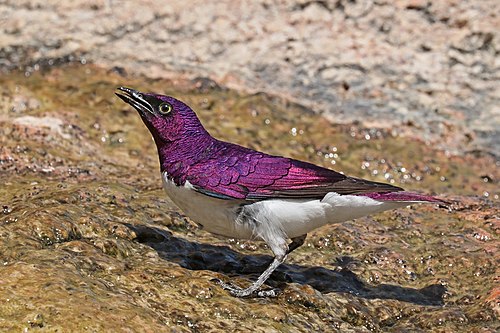
Violet-backed Starling
Cinnyricinclus leucogaster

Red-winged Starling
Onychognathus morio

Wattled Starling
Creatophora cinerea

Waller's Starling
Onychognathus walleri

Abbott's Starling
Poeoptera femoralis

Common Bulbul
Pycnonotus barbatus

Streaky Seedeater
Crithagra striolata

Hunter's Cisticola
Cisticola hunteri
📅 Monthly Probability
☀️ When They're Spotted
Most active during daytime hours (6am–6pm) · across all parks (global)
Global Distribution
Where this species is recorded worldwide. Restricted to human observations from 2019 onwards — the same kind of record and the same period the probabilities on this page are built from, so collar-tracking studies, camera-trap arrays and museum specimens are excluded. Around Santa Rosa that removes 5,924 GPS fixes from a handful of tagged jaguars.
where this species is recorded (GBIF density — it tracks where observers go, not how likely a sighting is) · parks where it occurs — tap a pin for the sighting probability there
Parks Where Found
Quick answers
What are the chances of seeing a Greater Blue-eared Starling in Aberdare National Park?
About 12% of wildlife watchers report a Greater Blue-eared Starling sighting in Aberdare National Park, based on 60 days of visitor records from GBIF citizen-science data.
When is the best time to see Greater Blue-eared Starling in Aberdare National Park?
March has the highest sighting rate for Greater Blue-eared Starling in Aberdare National Park in our monthly data.