


Senegal Kassina
Kassina senegalensis
- KingdomAnimalia (Animals)
- PhylumChordata (Cordats)
- ClassAmphibia (Amfibis)
- OrderAnura (Anurs)
- FamilyHyperoliidae (African Reed Frogs)
- GenusKassina
- SpeciesKassina senegalensis (Senegal Kassina)
Kassina senegalensis, also known as the Senegal running frog, along with many other common names, is a species of frog native to much of Africa. It is a small and solidly-built species with large eyes. Most of the body is greyish-black, but there are brown bands and spots on certain parts. They can be found in many types of habitats, such as shrublands, grasslands, and wetlands, at elevations as high as 2,000 metres (1.2 mi). Their breeding occurs in water, where eggs are laid in various locations and fertilised one by one. They eat a variety of arthropods and secrete peptides from their skin to avoid becoming prey themselves. Wikipedia →
Closest Relatives at Gorongosa National Park

Painted Reed Frog
Hyperolius marmoratus

Water Lily Reed Frog
Hyperolius pusillus

Fornasini's Spiny Reed Frog
Afrixalus fornasini

Snoring Leaf-folding Frog
Afrixalus crotalus

Tinker Reed Frog
Hyperolius tuberilinguis

Grey Foam-nest Treefrog
Chiromantis xerampelina

African Split-skin Toad
Schismaderma carens

Red-Banded Rubber Frog
Phrynomantis bifasciatus

Common Squeaker
Arthroleptis stenodactylus
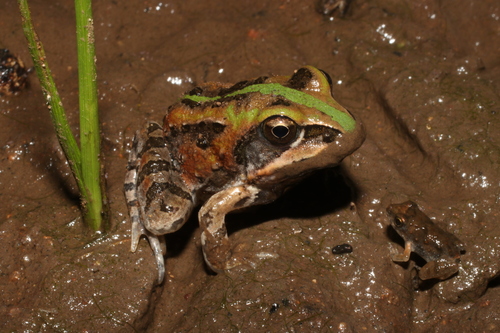
Ornate frog
Hildebrandtia ornata

Dwarf Squeaker
Arthroleptis xenodactyloides

Chimanimani Stream Frog
Strongylopus rhodesianus
📅 Monthly Probability
Fewer than 5 records of Senegal Kassina at Gorongosa National Park — not enough to chart months honestly.
☀️🌙 When They're Spotted
Active throughout day and night · across all parks (global)
Global Distribution
Where this species is recorded worldwide. Restricted to human observations from 2019 onwards — the same kind of record and the same period the probabilities on this page are built from, so collar-tracking studies, camera-trap arrays and museum specimens are excluded. Around Santa Rosa that removes 5,924 GPS fixes from a handful of tagged jaguars.
where this species is recorded (GBIF density — it tracks where observers go, not how likely a sighting is) · parks where it occurs — tap a pin for the sighting probability there