


Hildebrandt's Starling
Lamprotornis hildebrandti
- KingdomAnimalia (Animals)
- PhylumChordata (Cordats)
- ClassAves (Aus)
- OrderPasseriformes
- FamilySturnidae (Starlings)
- GenusLamprotornis (Glossy Starlings and Allies)
- SpeciesLamprotornis hildebrandti (Hildebrandt's Starling)
Hildebrandt's starling (Lamprotornis hildebrandti) is a species of starling in the family Sturnidae. It forms a superspecies with and has previously been included in the same species as Shelley's starling, a migratory species ranging from Ethiopia and Somalia to Kenya. Both of these species have also been combined into a superspecies with the chestnut-bellied starling of West Africa. It was originally placed in the now defunct genus Notauges. The species is named after Johann Maria Hildebrandt, a German collector who was the first European to obtain specimens. Wikipedia →
<5% of wildlife watchers report a Hildebrandt's Starling sighting in Arusha National Park, based on 10 days of visitor records from GBIF citizen-science data.
Closest Relatives at Arusha National Park

Superb Starling
Lamprotornis superbus

Rüppell's Glossy-starling
Lamprotornis purpuroptera

Ashy Starling
Lamprotornis unicolor

Waller's Starling
Onychognathus walleri

Kenrick's Starling
Poeoptera kenricki

Red-winged Starling
Onychognathus morio
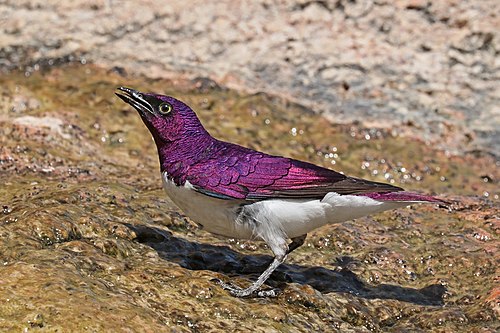
Violet-backed Starling
Cinnyricinclus leucogaster

Abbott's Starling
Poeoptera femoralis

Wattled Starling
Creatophora cinerea

Common Bulbul
Pycnonotus barbatus

Tropical Boubou
Laniarius major

Northern Fiscal
Lanius humeralis
📅 Monthly Probability
☀️ When They're Spotted
Most active during daytime hours (6am–6pm) · across all parks (global)
Global Distribution
Where this species is recorded worldwide. Restricted to human observations from 2019 onwards — the same kind of record and the same period the probabilities on this page are built from, so collar-tracking studies, camera-trap arrays and museum specimens are excluded. Around Santa Rosa that removes 5,924 GPS fixes from a handful of tagged jaguars.
where this species is recorded (GBIF density — it tracks where observers go, not how likely a sighting is) · parks where it occurs — tap a pin for the sighting probability there
Parks Where Found
| # | Park | Country | Probability |
|---|---|---|---|
| 1 | Serengeti National Park | 🇹🇿 Tanzania | |
| 2 | Ngorongoro Conservation Area | 🇹🇿 Tanzania | |
| 3 | Tsavo West National Park | 🇰🇪 Kenya | |
| 4 | Tarangire National Park | 🇹🇿 Tanzania | |
| 5 | Nairobi National Park | 🇰🇪 Kenya | |
| 6 | Masai Mara National Reserve | 🇰🇪 Kenya | |
| 7 | Mkomazi National Park | 🇹🇿 Tanzania | |
| 8 | Lake Manyara National Park | 🇹🇿 Tanzania | |
| 9 | Amboseli National Park | 🇰🇪 Kenya | |
| 10 | Tsavo East National Park | 🇰🇪 Kenya | |
| 11 | Samburu National Reserve | 🇰🇪 Kenya | |
| 12 | Arusha National Park | 🇹🇿 Tanzania | |
| 13 | Lake Nakuru National Park | 🇰🇪 Kenya | |
| 14 | Meru National Park | 🇰🇪 Kenya | |
| 15 | Aberdare National Park | 🇰🇪 Kenya |
Quick answers
What are the chances of seeing a Hildebrandt's Starling in Arusha National Park?
About 2% of wildlife watchers report a Hildebrandt's Starling sighting in Arusha National Park, based on 10 days of visitor records from GBIF citizen-science data.
When is the best time to see Hildebrandt's Starling in Arusha National Park?
June has the highest sighting rate for Hildebrandt's Starling in Arusha National Park in our monthly data.