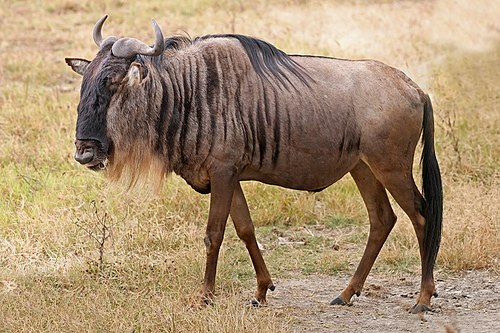


Blue Wildebeest
Connochaetes taurinus
- KingdomAnimalia (Animals)
- PhylumChordata (Cordats)
- ClassMammalia (Mamífers)
- OrderArtiodactyla (Artiodàctils)
- FamilyBovidae (Bòvids)
- GenusConnochaetes (Wildebeests)
- SpeciesConnochaetes taurinus (Blue Wildebeest)
The blue wildebeest (Connochaetes taurinus), also called the common wildebeest, white-bearded gnu or brindled gnu, is a large antelope and one of the two species of wildebeest. It is placed in the genus Connochaetes and family Bovidae, and has a close taxonomic relationship with the black wildebeest. The blue wildebeest is known to have five subspecies. This broad-shouldered antelope has a muscular, front-heavy appearance, with a distinctive, robust muzzle. Young blue wildebeest are born tawny brown, and begin to take on their adult coloration at the age of 2 months. The adults' hues range from a deep slate or bluish-gray to light gray or even grayish-brown. Wikipedia →
20–30% of wildlife watchers report a Blue Wildebeest sighting in Tsavo West National Park, based on 23 days of visitor records from GBIF citizen-science data.
Closest Relatives at Tsavo West National Park

African Buffalo
Syncerus caffer

East African Oryx
Oryx beisa

Hartebeest
Alcelaphus buselaphus

Lesser Kudu
Tragelaphus imberbis

Impala
Aepyceros melampus

Common Eland
Taurotragus oryx

Waterbuck
Kobus ellipsiprymnus

Grant's Gazelle
Nanger granti

Klipspringer
Oreotragus oreotragus

Gerenuk
Litocranius walleri

Northern Bushbuck
Tragelaphus scriptus

Steenbok
Raphicerus campestris
📅 Monthly Probability
☀️ When They're Spotted
Most active during daytime hours (6am–6pm) · across all parks (global)
Global Distribution
Where this species is recorded worldwide. Restricted to human observations from 2019 onwards — the same kind of record and the same period the probabilities on this page are built from, so collar-tracking studies, camera-trap arrays and museum specimens are excluded. Around Santa Rosa that removes 5,924 GPS fixes from a handful of tagged jaguars.
where this species is recorded (GBIF density — it tracks where observers go, not how likely a sighting is) · parks where it occurs — tap a pin for the sighting probability there
Parks Where Found
Quick answers
What are the chances of seeing a Blue Wildebeest in Tsavo West National Park?
About 28% of wildlife watchers report a Blue Wildebeest sighting in Tsavo West National Park, based on 23 days of visitor records from GBIF citizen-science data.
When is the best time to see Blue Wildebeest in Tsavo West National Park?
September has the highest sighting rate for Blue Wildebeest in Tsavo West National Park in our monthly data.