


Brown-backed Needletail
Hirundapus giganteus
- KingdomAnimalia (Animals)
- PhylumChordata (Cordats)
- ClassAves (Aus)
- OrderApodiformes (Swifts and Hummingbirds)
- FamilyApodidae (Swifts)
- GenusHirundapus (Typical Needletails)
- SpeciesHirundapus giganteus (Brown-backed Needletail)
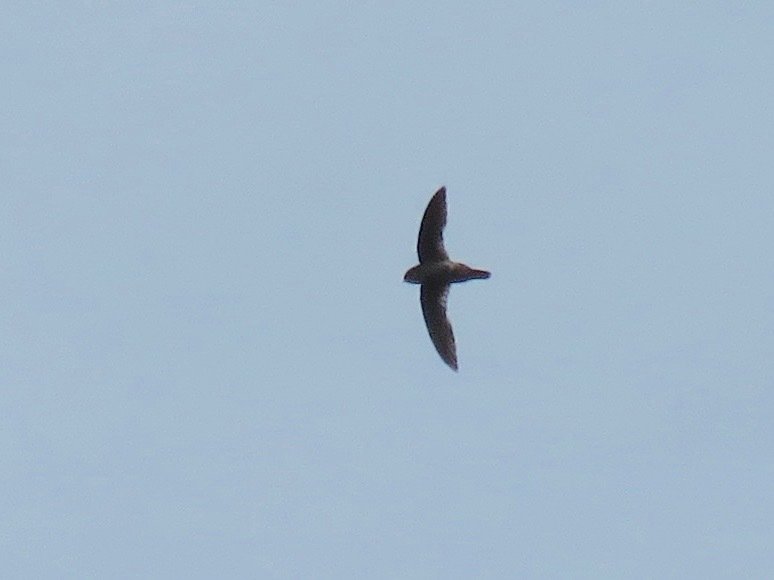
The brown-backed needletail (Hirundapus giganteus), or brown needletail, is a large swift. These birds have very short legs which they use only mainly for clinging to vertical surfaces. They never settle voluntarily on the ground and spend most of their lives in the air, living on the insects they catch in their beaks. These swifts are resident breeders in hill forests in southern India and southeast Asia, extending to the Greater Sunda islands of Indonesia and Palawan in the southern Philippines. They build their nests in rock crevices in cliffs, laying 3-5 eggs. The flight is impressively fast, even compared to other swifts. Wikipedia →
<5% of wildlife watchers report a Brown-backed Needletail sighting in Kinabalu Park, based on 9 days of visitor records from GBIF citizen-science data.
Closest Relatives at Kinabalu Park

White-throated Needletail
Hirundapus caudacutus

Plume-toed Swiftlet
Collocalia affinis

Silver-rumped Needletail
Rhaphidura leucopygialis

House Swift
Apus nipalensis
Waterfall Swift
Hydrochous gigas

White-nest Swiftlet
Aerodramus fuciphagus

Asian Palm-Swift
Cypsiurus balasiensis

Pacific Swift
Apus pacificus

Black-nest Swiftlet
Aerodramus maximus

Bornean Swiftlet
Collocalia dodgei

Gray-rumped Treeswift
Hemiprocne longipennis

Whiskered Treeswift
Hemiprocne comata
📅 Monthly Probability
🌅 When They're Spotted
Most active at dawn and dusk · across all parks (global)
Global Distribution
Where this species is recorded worldwide. Restricted to human observations from 2019 onwards — the same kind of record and the same period the probabilities on this page are built from, so collar-tracking studies, camera-trap arrays and museum specimens are excluded. Around Santa Rosa that removes 5,924 GPS fixes from a handful of tagged jaguars.
where this species is recorded (GBIF density — it tracks where observers go, not how likely a sighting is) · parks where it occurs — tap a pin for the sighting probability there
Parks Where Found
| # | Park | Country | Probability |
|---|---|---|---|
| 1 | Khao Yai National Park | 🇹🇭 Thailand | |
| 2 | Periyar National Park | 🇮🇳 India | |
| 3 | Cuc Phuong National Park | 🇻🇳 Vietnam | |
| 4 | Kaeng Krachan National Park | 🇹🇭 Thailand | |
| 5 | Sinharaja Forest Reserve | 🇱🇰 Sri Lanka | |
| 6 | Danum Valley Conservation Area | 🇲🇾 Malaysia | |
| 7 | Cat Tien National Park | 🇻🇳 Vietnam | |
| 8 | Khao Luang National Park | 🇹🇭 Thailand | |
| 9 | Nagarhole National Park | 🇮🇳 India | |
| 10 | Kinabatangan Wildlife Sanctuary | 🇲🇾 Malaysia | |
| 11 | Bali Barat National Park | 🇮🇩 Indonesia | |
| 12 | Khao Sok National Park | 🇹🇭 Thailand | |
| 13 | Namdapha National Park | 🇮🇳 India | |
| 14 | Yala National Park | 🇱🇰 Sri Lanka | |
| 15 | Doi Inthanon National Park | 🇹🇭 Thailand | |
| 16 | Kinabalu Park | 🇲🇾 Malaysia | |
| 17 | Way Kambas National Park | 🇮🇩 Indonesia | |
| 18 | Eravikulam National Park | 🇮🇳 India | |
| 19 | Kerinci Seblat National Park | 🇮🇩 Indonesia | |
| 20 | Royal Manas National Park | 🇧🇹 Bhutan | |
| 21 | Kaziranga National Park | 🇮🇳 India |
Quick answers
What are the chances of seeing a Brown-backed Needletail in Kinabalu Park?
About 0% of wildlife watchers report a Brown-backed Needletail sighting in Kinabalu Park, based on 9 days of visitor records from GBIF citizen-science data.
When is the best time to see Brown-backed Needletail in Kinabalu Park?
March has the highest sighting rate for Brown-backed Needletail in Kinabalu Park in our monthly data.