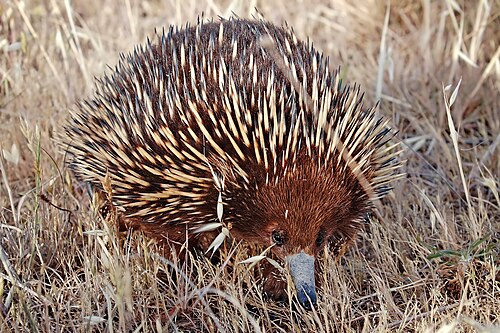


Short-beaked Echidna
Tachyglossus aculeatus
- KingdomAnimalia (Animals)
- PhylumChordata (Cordats)
- ClassMammalia (Mamífers)
- OrderMonotremata (Monotremes)
- FamilyTachyglossidae (Echidnas)
- GenusTachyglossus (Short-beaked echidnas)
- SpeciesTachyglossus aculeatus (Short-beaked Echidna)
The short-beaked echidna (Tachyglossus aculeatus), also known as the common echidna, or short-nosed echidna, is one of four living species of echidna, and the only member of the genus Tachyglossus, from Ancient Greek ταχύς (takhús), meaning "fast", and γλῶσσα (glôssa), meaning "tongue". It is covered in fur and spines and has a distinctive snout and a specialised tongue, which it uses to catch its insect prey at a great speed. Like the other extant monotremes, the short-beaked echidna lays eggs; the monotremes are the only living group of mammals to do so. The short-beaked echidna has extremely strong front limbs and claws, which allow it to burrow quickly with great power. As it needs to be able to survive underground, it has a significant tolerance to high levels of carbon dioxide and low levels of oxygen. It has no weapons or fighting ability but deters predators by curling into a ball and protecting itself with its spines. Wikipedia →
20–30% of wildlife watchers report a Short-beaked Echidna sighting in Blue Mountains National Park, based on 130 days of visitor records from GBIF citizen-science data.
Closest Relatives at Blue Mountains National Park

📅 Monthly Probability
☀️ When They're Spotted
Most active during daytime hours (6am–6pm) · across all parks (global)
Global Distribution
Where this species is recorded worldwide. Restricted to human observations from 2019 onwards — the same kind of record and the same period the probabilities on this page are built from, so collar-tracking studies, camera-trap arrays and museum specimens are excluded. Around Santa Rosa that removes 5,924 GPS fixes from a handful of tagged jaguars.
where this species is recorded (GBIF density — it tracks where observers go, not how likely a sighting is) · parks where it occurs — tap a pin for the sighting probability there
Parks Where Found
| # | Park | Country | Probability |
|---|---|---|---|
| 1 | Cradle Mountain-Lake St Clair National Park | 🇦🇺 Australia | |
| 2 | Flinders Ranges National Park | 🇦🇺 Australia | |
| 3 | Maria Island National Park | 🇦🇺 Australia | |
| 4 | Grampians National Park | 🇦🇺 Australia | |
| 5 | Kosciuszko National Park | 🇦🇺 Australia | |
| 6 | Freycinet National Park | 🇦🇺 Australia | |
| 7 | Booderee National Park | 🇦🇺 Australia | |
| 8 | Great Otway National Park | 🇦🇺 Australia | |
| 9 | Wilsons Promontory National Park | 🇦🇺 Australia | |
| 10 | Royal National Park | 🇦🇺 Australia | |
| 11 | Noosa National Park | 🇦🇺 Australia | |
| 12 | Blue Mountains National Park | 🇦🇺 Australia | |
| 13 | Daintree National Park | 🇦🇺 Australia | |
| 14 | Springbrook National Park | 🇦🇺 Australia | |
| 15 | Lamington National Park | 🇦🇺 Australia | |
| 16 | Nitmiluk National Park | 🇦🇺 Australia | |
| 17 | Litchfield National Park | 🇦🇺 Australia | |
| 18 | Ningaloo Marine Park | 🇦🇺 Australia | |
| 19 | Kakadu National Park | 🇦🇺 Australia |
Quick answers
What are the chances of seeing a Short-beaked Echidna in Blue Mountains National Park?
About 24% of wildlife watchers report a Short-beaked Echidna sighting in Blue Mountains National Park, based on 130 days of visitor records from GBIF citizen-science data.
When is the best time to see Short-beaked Echidna in Blue Mountains National Park?
November has the highest sighting rate for Short-beaked Echidna in Blue Mountains National Park in our monthly data.