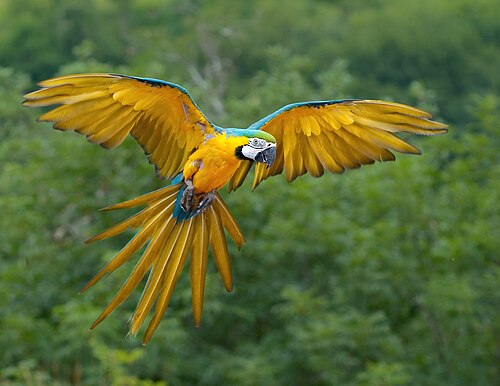


Blue-and-yellow Macaw
Ara ararauna
- KingdomAnimalia (Animals)
- PhylumChordata (Cordats)
- ClassAves (Aus)
- OrderPsittaciformes (Parrots)
- FamilyPsittacidae (New World and African Parrots)
- GenusAra
- SpeciesAra ararauna (Blue-and-yellow Macaw)
The blue-and-yellow macaw (Ara ararauna), also known as the blue-and-gold macaw, is a large Neotropical parrot with a mostly blue dorsum, light yellow/orange venter, and gradient hues of green on top of its head. It is a member of the large group of neotropical parrots known as macaws. It inhabits forest (especially varzea, but also in open sections of terra firme or unflooded forest), woodland, and savannah of tropical Central and South America, as well as the island of Trinidad in the Caribbean. They are popular in aviculture because of their striking color, ability to talk, ready availability in the marketplace, and close bonding to humans. It is the most commonly kept macaw species in captivity worldwide as a pet or companion parrot and is also the cheapest among the large macaws. As of 2025, there are 1 million blue and gold macaws living in captivity worldwide, one of the highest populations of any large parrot in captivity. Wikipedia →
Closest Relatives at Farallones de Cali National Natural Park

Chestnut-fronted Macaw
Ara severus

Scarlet-fronted Parakeet
Aratinga wagleri

Bronze-winged Parrot
Pionus chalcopterus

Spectacled Parrotlet
Forpus conspicillatus

Blue-headed Parrot
Pionus menstruus

Scaly-naped Parrot
Amazona mercenaria

Yellow-crowned Parrot
Amazona ochrocephala

Barred Parakeet
Bolborhynchus lineola

Rose-faced Parrot
Pionopsitta pulchra
Blue-fronted Parrotlet
Touit dilectissimus

Red-lored Parrot
Amazona autumnalis

Orange-chinned Parakeet
Brotogeris jugularis
📅 Monthly Probability
Fewer than 5 records of Blue-and-yellow Macaw at Farallones de Cali National Natural Park — not enough to chart months honestly.
☀️ When They're Spotted
Most active during daytime hours (6am–6pm) · across all parks (global)
Global Distribution
Where this species is recorded worldwide. Restricted to human observations from 2019 onwards — the same kind of record and the same period the probabilities on this page are built from, so collar-tracking studies, camera-trap arrays and museum specimens are excluded. Around Santa Rosa that removes 5,924 GPS fixes from a handful of tagged jaguars.
where this species is recorded (GBIF density — it tracks where observers go, not how likely a sighting is) · parks where it occurs — tap a pin for the sighting probability there