


Mexican Mushroomtongue Salamander
Bolitoglossa mexicana
- KingdomAnimalia (Animals)
- PhylumChordata (Cordats)
- ClassAmphibia (Amfibis)
- OrderCaudata (Caudats)
- FamilyPlethodontidae (Lungless Salamanders)
- GenusBolitoglossa (Mushroom-tongued Salamanders)
- SpeciesBolitoglossa mexicana (Mexican Mushroomtongue Salamander)
The Mexican climbing salamander (Bolitoglossa mexicana) is a species of salamander in the family Plethodontidae. It is found in Belize, Guatemala, Honduras, Mexico, and possibly Nicaragua. Its natural habitats are subtropical or tropical dry forests, subtropical or tropical moist lowland forests, subtropical or tropical moist montane forests, plantations, and rural gardens. It is threatened by habitat loss. Like other members of the family Plethodontidae, the Mexican climbing salamander is lungless and breathes entirely through its skin, which requires moist habitats for gas exchange and limits water loss. It reproduces through direct development, with embryos hatching as miniature adults rather than passing through a free-living larval stage. Wikipedia →
10–20% of wildlife watchers report a Mexican Mushroomtongue Salamander sighting in Cusuco National Park, based on 7 days of visitor records from GBIF citizen-science data.
Closest Relatives at Cusuco National Park
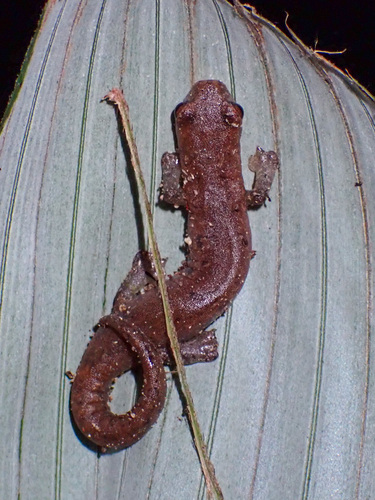
Nymph Salamander
Bolitoglossa nympha

Conant's Mushroomtongue Salamander
Bolitoglossa conanti

Rufescent Salamander
Bolitoglossa rufescens

Giant Palm Salamander
Bolitoglossa dofleini

El Cusuco salamander
Bolitoglossa diaphora
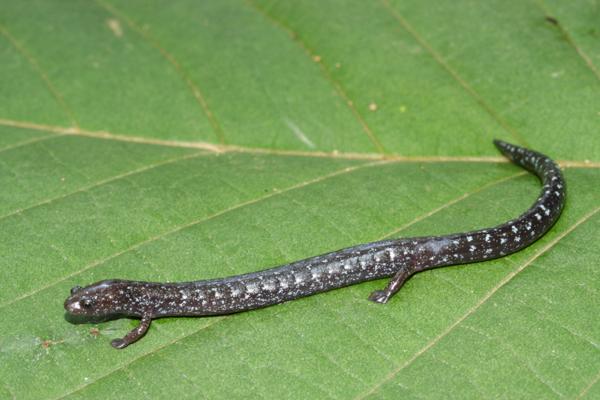
Central American Worm Salamander
Oedipina elongata
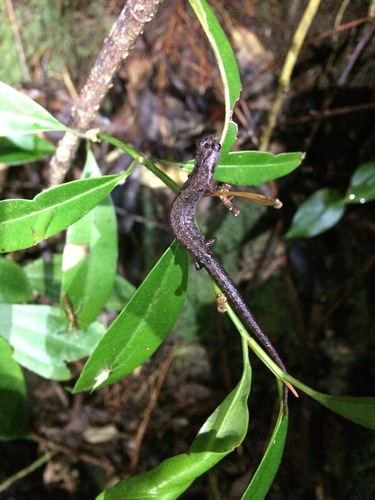
Merendon Moss Salamander
Nototriton brodiei

Cusuco Worm Salamander
Oedipina tomasi
📅 Monthly Probability
☀️🌙 When They're Spotted
Active throughout day and night · across all parks (global)
Global Distribution
Where this species is recorded worldwide. Restricted to human observations from 2019 onwards — the same kind of record and the same period the probabilities on this page are built from, so collar-tracking studies, camera-trap arrays and museum specimens are excluded. Around Santa Rosa that removes 5,924 GPS fixes from a handful of tagged jaguars.
where this species is recorded (GBIF density — it tracks where observers go, not how likely a sighting is) · parks where it occurs — tap a pin for the sighting probability there
Parks Where Found
| # | Park | Country | Probability |
|---|---|---|---|
| 1 | Pico Bonito National Park | 🇭🇳 Honduras | |
| 2 | Montes Azules Biosphere Reserve | 🇲🇽 Mexico | |
| 3 | Cusuco National Park | 🇭🇳 Honduras | |
| 4 | Cockscomb Basin Wildlife Sanctuary | 🇧🇿 Belize | |
| 5 | Celaque National Park | 🇭🇳 Honduras | |
| 6 | Lago de Yojoa | 🇭🇳 Honduras | |
| 7 | Cerro Azul Meámbar National Park | 🇭🇳 Honduras | |
| 8 | Calakmul Biosphere Reserve | 🇲🇽 Mexico |
Quick answers
What are the chances of seeing a Mexican Mushroomtongue Salamander in Cusuco National Park?
About 11% of wildlife watchers report a Mexican Mushroomtongue Salamander sighting in Cusuco National Park, based on 7 days of visitor records from GBIF citizen-science data.
When is the best time to see Mexican Mushroomtongue Salamander in Cusuco National Park?
July has the highest sighting rate for Mexican Mushroomtongue Salamander in Cusuco National Park in our monthly data.