


Painted Hunting Dog
Lycaon pictus
- KingdomAnimalia (Animals)
- PhylumChordata (Cordats)
- ClassMammalia (Mamífers)
- OrderCarnivora (Carnívors)
- FamilyCanidae (Canids)
- GenusLycaon (African wild dogs)
- SpeciesLycaon pictus (Painted Hunting Dog)
The African wild dog (Lycaon pictus), also called painted dog and Cape hunting dog, is a wild canine native to sub-Saharan Africa. It is the largest wild canine in Africa and the only extant member of the genus Lycaon, which is distinguished from Canis by dentition highly specialised for a hypercarnivorous diet and by a lack of dewclaws. An estimated 6,600 adults (including 1,400 mature individuals) live in 39 subpopulations, all threatened by habitat fragmentation, human persecution, and outbreaks of disease. As the largest subpopulation probably consists of fewer than 250 individuals, the African wild dog has been listed as endangered on the IUCN Red List since 1990. The African wild dog is a specialized hunter of terrestrial ungulates, mostly hunting at dawn and dusk, but it also displays diurnal activity. It captures its prey by using stamina and cooperative hunting to exhaust them. Wikipedia →
20–30% of wildlife watchers report a Painted Hunting Dog sighting in Kafue National Park, based on 10 days of visitor records from GBIF citizen-science data.
Closest Relatives at Kafue National Park

Lion
Panthera leo

Leopard
Panthera pardus

Banded Mongoose
Mungos mungo
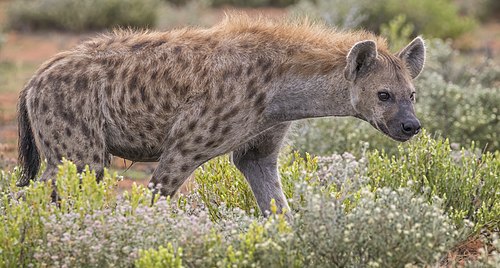
Spotted Hyena
Crocuta crocuta

African Civet
Civettictis civetta

Cheetah
Acinonyx jubatus

White-tailed Mongoose
Ichneumia albicauda

Slender Mongoose
Galerella sanguinea

African Wildcat
Felis lybica

Spotted-necked Otter
Hydrictis maculicollis

Serval
Leptailurus serval

Meller's Mongoose
Rhynchogale melleri
📅 Monthly Probability
☀️ When They're Spotted
Most active during daytime hours (6am–6pm) · across all parks (global)
Global Distribution
Where this species is recorded worldwide. Restricted to human observations from 2019 onwards — the same kind of record and the same period the probabilities on this page are built from, so collar-tracking studies, camera-trap arrays and museum specimens are excluded. Around Santa Rosa that removes 5,924 GPS fixes from a handful of tagged jaguars.
where this species is recorded (GBIF density — it tracks where observers go, not how likely a sighting is) · parks where it occurs — tap a pin for the sighting probability there
Parks Where Found
| # | Park | Country | Probability |
|---|---|---|---|
| 1 | Lower Zambezi National Park | 🇿🇲 Zambia | |
| 2 | Mana Pools National Park | 🇿🇼 Zimbabwe | |
| 3 | South Luangwa National Park | 🇿🇲 Zambia | |
| 4 | Moremi Game Reserve | 🇧🇼 Botswana | |
| 5 | Gorongosa National Park | 🇲🇿 Mozambique | |
| 6 | Ruaha National Park | 🇹🇿 Tanzania | |
| 7 | Kruger National Park | 🇿🇦 South Africa | |
| 8 | Kafue National Park | 🇿🇲 Zambia | |
| 9 | Hwange National Park | 🇿🇼 Zimbabwe | |
| 10 | Chobe National Park | 🇧🇼 Botswana | |
| 11 | Gonarezhou National Park | 🇿🇼 Zimbabwe | |
| 12 | Tsavo West National Park | 🇰🇪 Kenya | |
| 13 | Liwonde National Park | 🇲🇼 Malawi | |
| 14 | Hluhluwe-Imfolozi Park | 🇿🇦 South Africa | |
| 15 | Tsavo East National Park | 🇰🇪 Kenya | |
| 16 | Selous Game Reserve | 🇹🇿 Tanzania | |
| 17 | Mkomazi National Park | 🇹🇿 Tanzania | |
| 18 | Mikumi National Park | 🇹🇿 Tanzania | |
| 19 | Samburu National Reserve | 🇰🇪 Kenya | |
| 20 | Pilanesberg National Park | 🇿🇦 South Africa | |
| 21 | Serengeti National Park | 🇹🇿 Tanzania |
Quick answers
What are the chances of seeing a Painted Hunting Dog in Kafue National Park?
About 29% of wildlife watchers report a Painted Hunting Dog sighting in Kafue National Park, based on 10 days of visitor records from GBIF citizen-science data.
When is the best time to see Painted Hunting Dog in Kafue National Park?
July has the highest sighting rate for Painted Hunting Dog in Kafue National Park in our monthly data.