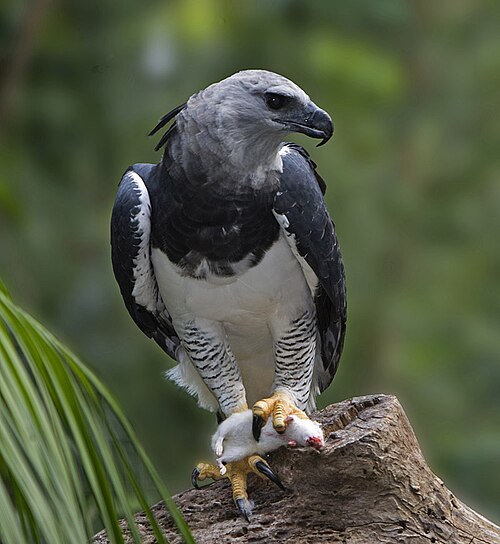


Harpy Eagle
Harpia harpyja
- KingdomAnimalia (Animals)
- PhylumChordata (Cordats)
- ClassAves (Aus)
- OrderAccipitriformes
- FamilyAccipitridae (Accipítrids)
- GenusHarpia
- SpeciesHarpia harpyja (Harpy Eagle)
The harpy eagle (Harpia harpyja) is a large neotropical species of eagle. It is also called the American harpy eagle to distinguish it from the Papuan eagle, which is sometimes known as the New Guinea harpy eagle or Papuan harpy eagle. It is the largest bird of prey throughout its range, and among the largest extant species of eagles in the world. It usually inhabits tropical lowland rainforests in the upper (emergent) canopy layer. Destruction of its natural habitat has caused it to vanish from many parts of its former range, and it is nearly extirpated from much of Central America. It is the only member of the genus Harpia, which, together with Harpyopsis, Macheiramphus and Morphnus, forms the subfamily Harpiinae. Wikipedia →
Closest Relatives at Brownsberg Nature Park

American Swallow-tailed Kite
Elanoides forficatus

Short-tailed Hawk
Buteo brachyurus

Broad-winged Hawk
Buteo platypterus

White Hawk
Leucopternis albicollis

Plumbeous Kite
Ictinia plumbea

Double-toothed Kite
Harpagus bidentatus

Gray-headed Kite
Leptodon cayanensis

Tiny Hawk
Accipiter superciliosus

Gray-lined Hawk
Buteo nitidus

Black-faced Hawk
Leucopternis melanops

Black-collared Hawk
Busarellus nigricollis

Great Black-Hawk
Buteogallus urubitinga
📅 Monthly Probability
Fewer than 5 records of Harpy Eagle at Brownsberg Nature Park — not enough to chart months honestly.
☀️ When They're Spotted
Most active during daytime hours (6am–6pm) · across all parks (global)
Global Distribution
Where this species is recorded worldwide. Restricted to human observations from 2019 onwards — the same kind of record and the same period the probabilities on this page are built from, so collar-tracking studies, camera-trap arrays and museum specimens are excluded. Around Santa Rosa that removes 5,924 GPS fixes from a handful of tagged jaguars.
where this species is recorded (GBIF density — it tracks where observers go, not how likely a sighting is) · parks where it occurs — tap a pin for the sighting probability there
Parks Where Found
| # | Park | Country | Probability |
|---|---|---|---|
| 1 | Sierra de la Macarena National Park | 🇨🇴 Colombia | |
| 2 | Darién National Park | 🇵🇦 Panama | |
| 3 | Cuyabeno Wildlife Reserve | 🇪🇨 Ecuador | |
| 4 | Yasuní National Park | 🇪🇨 Ecuador | |
| 5 | Manu National Park | 🇵🇪 Peru | |
| 6 | Anavilhanas National Park | 🇧🇷 Brazil | |
| 7 | Tambopata National Reserve | 🇵🇪 Peru | |
| 8 | Bastimentos Island National Marine Park | 🇵🇦 Panama | |
| 9 | La Amistad International Park (Panama) | 🇵🇦 Panama | |
| 10 | Brownsberg Nature Park | 🇸🇷 Suriname | |
| 11 | Amboró National Park | 🇧🇴 Bolivia | |
| 12 | Madidi National Park | 🇧🇴 Bolivia | |
| 13 | Amacayacu National Natural Park | 🇨🇴 Colombia | |
| 14 | Parque Estadual Encontro das Águas | 🇧🇷 Brazil | |
| 15 | Soberanía National Park | 🇵🇦 Panama |