


Crested Tern
Thalasseus bergii
- KingdomAnimalia (Animals)
- PhylumChordata (Cordats)
- ClassAves (Aus)
- OrderCharadriiformes (Caradriformes)
- FamilyLaridae (Gulls, Terns, and Skimmers)
- GenusThalasseus (Crested Terns)
- SpeciesThalasseus bergii (Crested Tern)
The greater crested tern (Thalasseus bergii), also called crested tern, swift tern, or great crested tern, is a tern in the family Laridae that nests in dense colonies on coastlines and islands in the tropical and subtropical Old World. Its four or five subspecies breed in the area from South Africa around the Indian Ocean to the central Pacific and Australia, all populations dispersing widely from the breeding range after nesting. This large tern is closely related to other species in its genus, but can be distinguished by its darker, battleship-grey upperparts, white forehead even in full breeding plumage, and greenish-tinged yellow (not orange or black) bill colour. The greater crested tern has dark grey upperparts, white underparts, a yellow bill, and a shaggy black crest that recedes in winter. Its young have a distinctive appearance, with strongly patterned grey, brown and white plumage, and rely on their parents for food for several months after they have fledged. Like all members of the genus Thalasseus, the greater crested tern feeds by plunge diving for fish, usually in marine environments; the male offers fish to the female as part of the courtship ritual. Wikipedia →
Closest Relatives at Kinabatangan Wildlife Sanctuary

Whiskered Tern
Chlidonias hybrida

White-winged Tern
Chlidonias leucopterus

Little Tern
Sternula albifrons

Black-naped Tern
Sterna sumatrana

Roseate Tern
Sterna dougallii

Gull-billed Tern
Gelochelidon nilotica
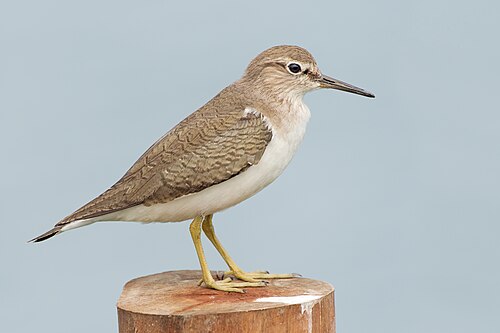
Common Sandpiper
Actitis hypoleucos

Wood Sandpiper
Tringa glareola

Oriental Pratincole
Glareola maldivarum

Green Sandpiper
Tringa ochropus

Grey-tailed Tattler
Tringa brevipes

Common Redshank
Tringa totanus
📅 Monthly Probability
Fewer than 5 records of Crested Tern at Kinabatangan Wildlife Sanctuary — not enough to chart months honestly.
☀️ When They're Spotted
Most active during daytime hours (6am–6pm) · across all parks (global)
Global Distribution
Where this species is recorded worldwide. Restricted to human observations from 2019 onwards — the same kind of record and the same period the probabilities on this page are built from, so collar-tracking studies, camera-trap arrays and museum specimens are excluded. Around Santa Rosa that removes 5,924 GPS fixes from a handful of tagged jaguars.
where this species is recorded (GBIF density — it tracks where observers go, not how likely a sighting is) · parks where it occurs — tap a pin for the sighting probability there
Parks Where Found
| # | Park | Country | Probability |
|---|---|---|---|
| 1 | Noosa National Park | 🇦🇺 Australia | |
| 2 | Ningaloo Marine Park | 🇦🇺 Australia | |
| 3 | Namib-Naukluft National Park | 🇳🇦 Namibia | |
| 4 | Freycinet National Park | 🇦🇺 Australia | |
| 5 | Maria Island National Park | 🇦🇺 Australia | |
| 6 | Wilsons Promontory National Park | 🇦🇺 Australia | |
| 7 | iSimangaliso Wetland Park | 🇿🇦 South Africa | |
| 8 | Table Mountain National Park | 🇿🇦 South Africa | |
| 9 | Booderee National Park | 🇦🇺 Australia | |
| 10 | Garden Route National Park | 🇿🇦 South Africa | |
| 11 | Great Otway National Park | 🇦🇺 Australia | |
| 12 | Bali Barat National Park | 🇮🇩 Indonesia | |
| 13 | Daintree National Park | 🇦🇺 Australia | |
| 14 | Royal National Park | 🇦🇺 Australia | |
| 15 | Yala National Park | 🇱🇰 Sri Lanka | |
| 16 | Addo Elephant National Park | 🇿🇦 South Africa | |
| 17 | Tsavo East National Park | 🇰🇪 Kenya | |
| 18 | Taroko National Park | 🇹🇼 Taiwan | |
| 19 | Cradle Mountain-Lake St Clair National Park | 🇦🇺 Australia | |
| 20 | Springbrook National Park | 🇦🇺 Australia | |
| 21 | Kerinci Seblat National Park | 🇮🇩 Indonesia | |
| 22 | Kinabatangan Wildlife Sanctuary | 🇲🇾 Malaysia | |
| 23 | Kinabalu Park | 🇲🇾 Malaysia |