


Japanese Fire Belly Newt
Cynops pyrrhogaster
- KingdomAnimalia (Animals)
- PhylumChordata (Cordats)
- ClassAmphibia (Amfibis)
- OrderCaudata (Caudats)
- FamilySalamandridae (True Salamanders and Newts)
- GenusCynops
- SpeciesCynops pyrrhogaster (Japanese Fire Belly Newt)
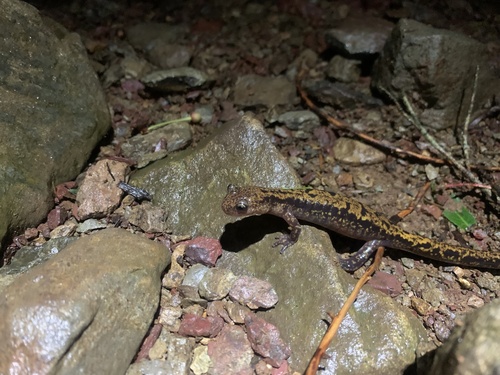
The Japanese fire-bellied newt or Japanese fire-bellied salamander (Cynops pyrrhogaster) is a species of newt endemic to Japan. The skin on its upper body is dark and its lower regions bright red, although coloration varies with age, genetics, and region. Adults are 8 to 15 cm (3.1 to 5.9 in) long. To deter predators, Japanese fire-bellied newts contain high levels of tetrodotoxin, a neurotoxin accumulated mainly from their diet. The species is found on many Japanese islands, including Honshu, Shikoku, and Kyushu. Their habitats include both natural and artificial bodies of water, as well as forests and grasslands. Wikipedia →
30–40% of wildlife watchers report a Japanese Fire Belly Newt sighting in Nikko National Park, based on 28 days of visitor records from GBIF citizen-science data.


📅 Monthly Probability
🌅 When They're Spotted
Most active at dawn and dusk · across all parks (global)
Global Distribution
Where this species is recorded worldwide. Restricted to human observations from 2019 onwards — the same kind of record and the same period the probabilities on this page are built from, so collar-tracking studies, camera-trap arrays and museum specimens are excluded. Around Santa Rosa that removes 5,924 GPS fixes from a handful of tagged jaguars.
where this species is recorded (GBIF density — it tracks where observers go, not how likely a sighting is) · parks where it occurs — tap a pin for the sighting probability there
Parks Where Found
| # | Park | Country | Probability |
|---|---|---|---|
| 1 | Nikko National Park | 🇯🇵 Japan |
More parks will be added in future updates.
Quick answers
What are the chances of seeing a Japanese Fire Belly Newt in Nikko National Park?
About 39% of wildlife watchers report a Japanese Fire Belly Newt sighting in Nikko National Park, based on 28 days of visitor records from GBIF citizen-science data.
When is the best time to see Japanese Fire Belly Newt in Nikko National Park?
May has the highest sighting rate for Japanese Fire Belly Newt in Nikko National Park in our monthly data.