


Anna's Hummingbird
Calypte anna
- KingdomAnimalia (Animals)
- PhylumChordata (Cordats)
- ClassAves (Aus)
- OrderApodiformes (Swifts and Hummingbirds)
- FamilyTrochilidae (Hummingbirds)
- GenusCalypte (Anna's and Costa's Hummingbirds)
- SpeciesCalypte anna (Anna's Hummingbird)
Anna's hummingbird (Calypte anna) is a North American species of hummingbird named after Anna Masséna, Duchess of Rivoli. It is native to western coastal regions of North America. Until the late 20th century, Anna's hummingbirds migrated from locations as far north as Alaska and coastal British Columbia, returning south to breed in Baja California and Southern California. Since the 1970s, ornamental plants in residential areas along the Pacific coast and inland deserts provided expanded nectar and nesting sites, allowing the species to expand its breeding range to northern coastal regions without migrating. Year-round residence of Anna's hummingbirds in the Pacific Northwest is an example of ecological release dependent on acclimation to colder winter temperatures, introduced plants, and human provision of nectar feeders during winter. These birds feed on nectar from flowers using a long extendable tongue. Wikipedia →
Closest Relatives at Grand Canyon National Park

Costa's Hummingbird
Calypte costae
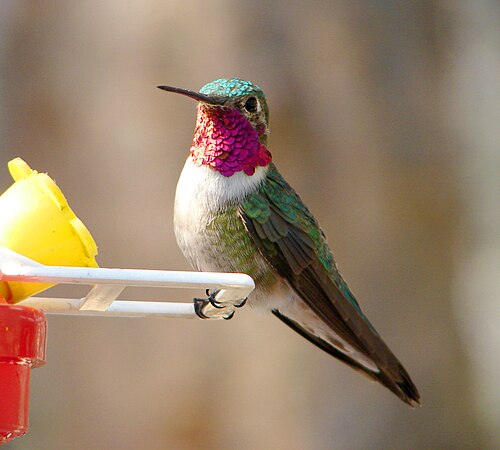
Broad-tailed Hummingbird
Selasphorus platycercus

Black-chinned Hummingbird
Archilochus alexandri

Rufous Hummingbird
Selasphorus rufus

Calliope Hummingbird
Selasphorus calliope

White-throated Swift
Aeronautes saxatalis

Vaux's Swift
Chaetura vauxi
📅 Monthly Probability
Fewer than 5 records of Anna's Hummingbird at Grand Canyon National Park — not enough to chart months honestly.
☀️ When They're Spotted
Most active during daytime hours (6am–6pm) · across all parks (global)
Global Distribution
Where this species is recorded worldwide. Restricted to human observations from 2019 onwards — the same kind of record and the same period the probabilities on this page are built from, so collar-tracking studies, camera-trap arrays and museum specimens are excluded. Around Santa Rosa that removes 5,924 GPS fixes from a handful of tagged jaguars.
where this species is recorded (GBIF density — it tracks where observers go, not how likely a sighting is) · parks where it occurs — tap a pin for the sighting probability there
Parks Where Found
| # | Park | Country | Probability |
|---|---|---|---|
| 1 | Channel Islands National Park | 🇺🇸 United States | |
| 2 | Sequoia and Kings Canyon National Parks | 🇺🇸 United States | |
| 3 | Joshua Tree National Park | 🇺🇸 United States | |
| 4 | Olympic National Park | 🇺🇸 United States | |
| 5 | Death Valley National Park | 🇺🇸 United States | |
| 6 | El Vizcaíno Biosphere Reserve | 🇲🇽 Mexico | |
| 7 | Yosemite National Park | 🇺🇸 United States | |
| 8 | Pacific Rim National Park Reserve | 🇨🇦 Canada | |
| 9 | Redwood National Park | 🇺🇸 United States | |
| 10 | Great Bear Rainforest | 🇨🇦 Canada | |
| 11 | Bahía de Loreto National Park | 🇲🇽 Mexico | |
| 12 | Zion National Park | 🇺🇸 United States | |
| 13 | Kluane National Park | 🇨🇦 Canada | |
| 14 | Big Bend National Park | 🇺🇸 United States | |
| 15 | Glacier National Park | 🇺🇸 United States | |
| 16 | Jasper National Park | 🇨🇦 Canada | |
| 17 | Grand Canyon National Park | 🇺🇸 United States | |
| 18 | Cumbres de Monterrey National Park | 🇲🇽 Mexico | |
| 19 | Banff National Park | 🇨🇦 Canada |