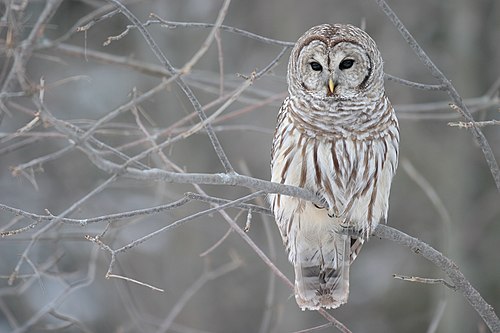


Barred Owl
Strix varia
- KingdomAnimalia (Animals)
- PhylumChordata (Cordats)
- ClassAves (Aus)
- OrderStrigiformes (Owls)
- FamilyStrigidae (Typical Owls)
- GenusStrix (Wood Owls and Allies)
- SpeciesStrix varia (Barred Owl)
The barred owl (Strix varia), also known as the northern barred owl, striped owl or, more informally, hoot owl or eight hooter, is a North American large species of owl. A member of the true owl family, Strigidae, they belong to the genus Strix, which is also the origin of the family's name under Linnaean taxonomy. Barred owls are largely native to eastern North America, but have expanded their range to the west coast of North America where they are considered invasive. Mature forests are their preferred habitat, but they can also acclimatise to various gradients of open woodlands. Their diet consists mainly of small mammals, but this species is an opportunistic predator and is known to prey upon other small vertebrates such as birds, reptiles, and amphibians, as well as a variety of invertebrates. Barred owls are brown to gray overall, with dark striping on the underside. Wikipedia →
10–20% of wildlife watchers report a Barred Owl sighting in Big Cypress National Preserve, based on 295 days of visitor records from GBIF citizen-science data.
Closest Relatives at Big Cypress National Preserve


📅 Monthly Probability
☀️🌙 When They're Spotted
Active throughout day and night · across all parks (global)
Global Distribution
Where this species is recorded worldwide. Restricted to human observations from 2019 onwards — the same kind of record and the same period the probabilities on this page are built from, so collar-tracking studies, camera-trap arrays and museum specimens are excluded. Around Santa Rosa that removes 5,924 GPS fixes from a handful of tagged jaguars.
where this species is recorded (GBIF density — it tracks where observers go, not how likely a sighting is) · parks where it occurs — tap a pin for the sighting probability there
Parks Where Found
| # | Park | Country | Probability |
|---|---|---|---|
| 1 | Congaree National Park | 🇺🇸 United States | |
| 2 | Big Cypress National Preserve | 🇺🇸 United States | |
| 3 | Everglades National Park | 🇺🇸 United States | |
| 4 | Acadia National Park | 🇺🇸 United States | |
| 5 | Shenandoah National Park | 🇺🇸 United States | |
| 6 | Great Smoky Mountains National Park | 🇺🇸 United States | |
| 7 | Riding Mountain National Park | 🇨🇦 Canada | |
| 8 | Olympic National Park | 🇺🇸 United States | |
| 9 | Voyageurs National Park | 🇺🇸 United States | |
| 10 | Cape Breton Highlands National Park | 🇨🇦 Canada | |
| 11 | Great Bear Rainforest | 🇨🇦 Canada | |
| 12 | Pacific Rim National Park Reserve | 🇨🇦 Canada | |
| 13 | Redwood National Park | 🇺🇸 United States | |
| 14 | Banff National Park | 🇨🇦 Canada | |
| 15 | Jasper National Park | 🇨🇦 Canada | |
| 16 | Glacier National Park | 🇺🇸 United States | |
| 17 | Isle Royale National Park | 🇺🇸 United States | |
| 18 | Elk Island National Park | 🇨🇦 Canada | |
| 19 | Grand Teton National Park | 🇺🇸 United States |
Quick answers
What are the chances of seeing a Barred Owl in Big Cypress National Preserve?
About 14% of wildlife watchers report a Barred Owl sighting in Big Cypress National Preserve, based on 295 days of visitor records from GBIF citizen-science data.
When is the best time to see Barred Owl in Big Cypress National Preserve?
December has the highest sighting rate for Barred Owl in Big Cypress National Preserve in our monthly data.