


Black-chinned Hummingbird
Archilochus alexandri
- KingdomAnimalia (Animals)
- PhylumChordata (Cordats)
- ClassAves (Aus)
- OrderApodiformes (Swifts and Hummingbirds)
- FamilyTrochilidae (Hummingbirds)
- GenusArchilochus (Ruby-throated and Black-chinned Hummingbirds)
- SpeciesArchilochus alexandri (Black-chinned Hummingbird)
The black-chinned hummingbird (Archilochus alexandri) is a hummingbird occupying a broad range of habitats from deserts to mountain forests and urban areas in the western United States, southern British Columbia, and Mexico. It is migratory, wintering as far south as Mexico. In sunlight, an iridescent purple gorget forming a ring below the black chin feathers is a male characteristic. When in flight and hovering, its wings make a low-pitched humming sound. Wikipedia →
20–30% of wildlife watchers report a Black-chinned Hummingbird sighting in Big Bend National Park, based on 898 days of visitor records from GBIF citizen-science data.
Closest Relatives at Big Bend National Park

Ruby-throated Hummingbird
Archilochus colubris

Lucifer Hummingbird
Calothorax lucifer
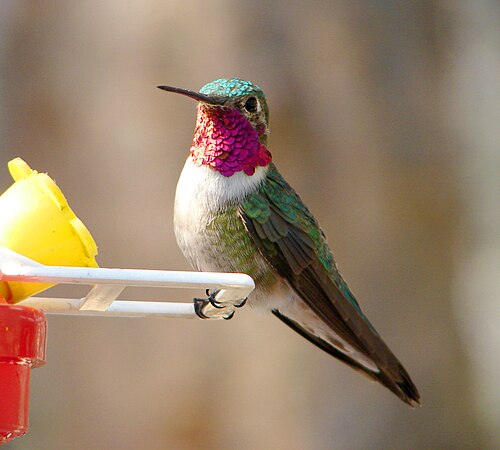
Broad-tailed Hummingbird
Selasphorus platycercus

Blue-throated Hummingbird
Lampornis clemenciae

Rufous Hummingbird
Selasphorus rufus

Allen's Hummingbird
Selasphorus sasin

Anna's Hummingbird
Calypte anna

Calliope Hummingbird
Selasphorus calliope

Rivoli's Hummingbird
Eugenes fulgens

Broad-billed Hummingbird
Cynanthus latirostris

White-throated Swift
Aeronautes saxatalis

Chimney Swift
Chaetura pelagica
📅 Monthly Probability
☀️ When They're Spotted
Most active during daytime hours (6am–6pm) · across all parks (global)
Global Distribution
Where this species is recorded worldwide. Restricted to human observations from 2019 onwards — the same kind of record and the same period the probabilities on this page are built from, so collar-tracking studies, camera-trap arrays and museum specimens are excluded. Around Santa Rosa that removes 5,924 GPS fixes from a handful of tagged jaguars.
where this species is recorded (GBIF density — it tracks where observers go, not how likely a sighting is) · parks where it occurs — tap a pin for the sighting probability there
Parks Where Found
| # | Park | Country | Probability |
|---|---|---|---|
| 1 | Big Bend National Park | 🇺🇸 United States | |
| 2 | Zion National Park | 🇺🇸 United States | |
| 3 | Grand Canyon National Park | 🇺🇸 United States | |
| 4 | Guadalupe Mountains National Park | 🇺🇸 United States | |
| 5 | Sequoia and Kings Canyon National Parks | 🇺🇸 United States | |
| 6 | Glacier National Park | 🇺🇸 United States | |
| 7 | Death Valley National Park | 🇺🇸 United States | |
| 8 | Cumbres de Monterrey National Park | 🇲🇽 Mexico | |
| 9 | Joshua Tree National Park | 🇺🇸 United States | |
| 10 | Rocky Mountain National Park | 🇺🇸 United States | |
| 11 | Grand Teton National Park | 🇺🇸 United States | |
| 12 | Banff National Park | 🇨🇦 Canada | |
| 13 | Yosemite National Park | 🇺🇸 United States | |
| 14 | Channel Islands National Park | 🇺🇸 United States | |
| 15 | El Vizcaíno Biosphere Reserve | 🇲🇽 Mexico | |
| 16 | Reserva de la Biosfera Mariposa Monarca | 🇲🇽 Mexico | |
| 17 | Yellowstone National Park | 🇺🇸 United States |
Quick answers
What are the chances of seeing a Black-chinned Hummingbird in Big Bend National Park?
About 20% of wildlife watchers report a Black-chinned Hummingbird sighting in Big Bend National Park, based on 898 days of visitor records from GBIF citizen-science data.
When is the best time to see Black-chinned Hummingbird in Big Bend National Park?
July has the highest sighting rate for Black-chinned Hummingbird in Big Bend National Park in our monthly data.